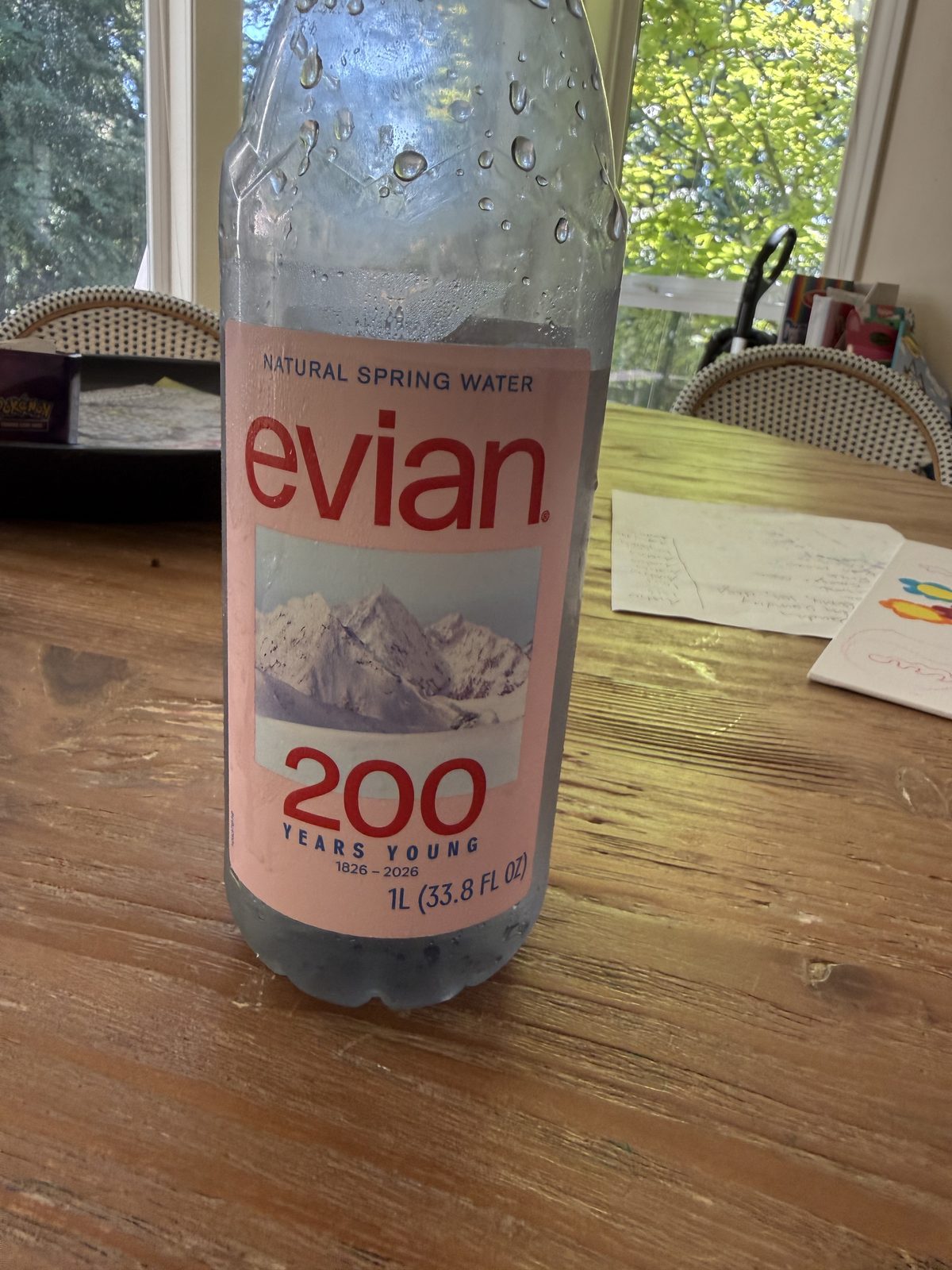
There is a bottle of Evian on my kitchen table.
I bought it at a Whole Foods in Tigard, Oregon.
That distance is part of the record.
The spring is in the French Alps. The shelf is outside Portland. Two hundred years of continuity is what makes that sentence unremarkable.
The label is pink. The mountains are still there. Beneath the name is a number large enough to do most of the work.
200
And underneath it:
YEARS YOUNG.
1826–2026.
It is excellent.
But not, I think, because it is excellent advertising.
That gives advertising too much credit.
The line works because almost nothing in it needed to be invented.
The mountain is true.
The spring is true.
The age is true.
The water is still coming from the same place.
And young, strangely enough, may be the oldest idea the brand owns.
This is not invention.
It is disclosure.
Water has a peculiar relationship with age.
Whisky wants to be old.
Wine can become more valuable because it waited.
Leather earns a patina. A watch can carry a century on its face and become more desirable because the mechanism survived it.
Nobody wants old water.
Water belongs to another vocabulary.
Fresh.
Clear.
Flowing.
Replenished.
We drink it after running. We put it beside the bed when we are sick. We splash it on our faces in the morning. We reach for it after an airplane, a bad night, a long afternoon outside, too much wine, too little sleep.
Water is one of the few things we consume because we want the body to feel newer afterward.
So there is a useful contradiction inside the bottle.
The source can be ancient.
The water must always feel young.
Evian did not manufacture that contradiction for an anniversary.
It inherited it.
Before there was a brand, there was a spring.
Evian dates the beginning of its recorded story to 1789, when the Marquis de Lessert drank from a spring in Évian-les-Bains owned by Monsieur Cachat and found the water unusually light and pleasant. Cachat began selling it locally. By 1806, the first thermal spa had opened. In 1826 came the first bottling facility at the Cachat source.
That order is worth noticing.
Spring.
Reputation.
Ritual.
Place.
Bottle.
Brand.
Not the other way around.
Nobody sat in a conference room and decided that wellness might be an attractive territory for a bottled-water company.
People were already coming to the water.
I was one of them, in a small way.
My mother went to high school in Lausanne, on the Swiss shore of Lake Geneva. When we were kids she took us back.
So I swam in that lake, the water Évian-les-Bains sits on, directly across from her school.
There was a castle standing in the water at the far end. Chillon. I can still see it when I close my eyes.
None of that is the spring. The spring is stone and fifteen years of darkness.
But the place was real to me before the label was.
The commercial proposition followed the physical fact.
In a market increasingly full of companies trying to find evidence for a position they have already chosen, this distinction is enormous.
Evian did not need a reason to believe.
It had a reason to exist.
The product makes the argument even cleaner.
Evian begins as rain and snow on the Gavot plateau in the French Alps. The water then moves slowly through layers of glacial rock for more than fifteen years before emerging at the Cachat spring. Along the way it acquires its naturally occurring mineral and electrolyte composition. Evian says it adds nothing for taste and does not enhance the water with extras.
Fifteen years underground.
Two hundred years of bottling.
And the word on the label is young.
Because young is not the same thing as new.
That may be the entire position.
New is manufactured.
Young is renewed.
The rain falls.
The snow melts.
The ground receives it.
Rock filters it.
The spring returns it.
Again.
Again.
Again.
The age of the source and the freshness of the water are not contradictory.
One produces the other.
Now walk the water aisle.
The category has become remarkably anxious about water being enough.
So it keeps adding things.
Electrolytes.
Trace minerals.
Vitamins.
Flavors.
Alkalinity.
Caffeine.
Protein.
Adaptogens.
Hydrogen.
Then come the diagrams explaining the things.
The numbers.
The chemistry.
The performance claims.
The clinical typography.
The ingredient names large enough to become brand names.
At the other end of the shelf, water has become an identity object.
Tall cans.
Aluminum.
Celebrity founders.
Designer bottles.
Counterculture language.
Fashion collaborations.
Packaging engineered to say something about the person holding it after the thirst has already been solved.
There is plenty of good work in both directions.
That is not the criticism.
The interesting thing is what the shelf reveals.
Water increasingly believes something must happen to it before it can command a premium.
An ingredient must be introduced.
A function must be claimed.
A technology must be named.
A cultural posture must be added.
Evian has an unusual privilege.
Its answer can be:
Nothing.
Or more precisely:
Nothing needed to be added.
Nature already did the complicated part.
Even the contemporary language of electrolytes becomes funny here.
Evian has calcium, magnesium and potassium among its naturally occurring mineral composition. It can participate in the technical language of hydration if it wants to. The difference is that those things were not formulated into the product by a product-development team. They were absorbed during the water’s passage through the geology beneath the Alps.
Ask the category where its functionality came from and you may get a laboratory.
Ask Evian and you get rock.
That is not anti-science.
It is provenance.
And provenance has a different economic character than functionality.
Function can be replicated.
An ingredient can be sourced.
A formulation can be reformulated.
A package can be copied before the original has finished trending.
But a specific spring in a specific place, carrying a specific geological record, with two centuries of commercial continuity behind it, is considerably harder to reverse-engineer.
The competitive advantage is not complexity.
It is jurisdiction.
This is where premium and luxury begin to separate.
Premium often demonstrates value through addition.
More material.
More ingredients.
More features.
More labor.
More explanation.
Luxury can sometimes demonstrate value through the confidence to stop.
The great tomato asks less of the sauce.
The exceptional wool asks less of the logo.
Good leather becomes more convincing when the surface is allowed to remain leather.
And water from a sufficiently meaningful source can become more valuable precisely because nobody felt compelled to turn it into something else.
The restraint is not emptiness.
The restraint is evidence of confidence.
The product was already complete.
Evian has not, of course, spent two hundred years standing still.
The distinction matters.
The company changed everything around the water.
It bottled it.
Distributed it.
Exported it.
Put it in glass and plastic.
Put it on restaurant tables and tennis courts.
Collaborated with designers and artists.
Moved through fashion, sport and culture.
It entered the United States and Canada in 1978 as an imported premium natural spring water and helped establish the possibility that bottled water itself could carry origin, distinction and price.
Evian has repeatedly changed the vessel.
It has repeatedly changed the expression.
It has repeatedly changed the room in which the product appears.
But the product remains answerable to the source.
That is a more useful idea of innovation than the endless alteration of the thing itself.
Change everything you can without changing the thing you cannot afford to lose.
Then there are the babies.
In France, Evian became known as l’eau des bébés, water for babies. By 1935 it was advertising itself as the water for the baby’s bottle, on posters set in pale pink.
The label on my table is pink for an anniversary. It was pink for the babies, ninety years earlier.
The association never left.
That fact matters because it moves young out of the copy department.
Long before youth became a brand platform, infancy was already attached to the product.
The modern brand later made babies famous.
It turned youth into a philosophy called Live Young.
Announcing the anniversary this year, Evian described two centuries rooted to one source as a legacy that continues to live young.
It did not need to draw the rest of the map.
The record draws it.
The chronology becomes almost embarrassingly coherent.
A spring associated with restoration.
A thermal spa.
Water taken home.
Water associated with babies.
Babies become cultural language.
Live Young.
And finally:
200 Years Young.
If you encountered only the campaign, you might call that positioning.
Look at the record and it becomes something else.
Disclosure.
That distinction is worth protecting.
Position has become confused with invention.
Companies are constantly asked what they want to stand for, as though the answer should emerge from aspiration.
What territory should we own?
What cultural tension should we enter?
What value should we attach ourselves to?
What story should we tell?
Those can be useful questions.
But they are downstream questions.
The better question comes first:
What is true enough to survive disclosure?
Then:
What in that truth is distinctive enough to matter?
What is durable enough to repeat?
What belongs to us strongly enough that a competitor cannot simply say it louder next quarter?
That is position.
Not a sentence imposed upon a company.
A judgment about which truth deserves jurisdiction over the rest.
The best position is rarely invented.
It is disclosed.
The work is not to decide what the company should mean.
It is to determine what is sufficiently true, sufficiently ownable and sufficiently important to deserve repetition.
Then put it on the record.
That is what makes the bottle on my table interesting.
200 Years Young is not powerful because somebody wrote four clever words.
It is powerful because the four words survive contact with the evidence.
You can walk backward through them.
Two hundred years?
There is the bottling date.
Young?
There is the water cycle.
There is the thermal history.
There are the babies.
There is Live Young.
There is the physical experience of drinking water itself.
There is the fifteen-year movement through stone that begins again each time rain and snow fall on the plateau.
The copy does not ask you to believe more than the record can carry.
It simply makes the record legible.
That is fidelity.
And perhaps that is why the bottle feels unusually premium on a shelf increasingly crowded with propositions.
It does not appear desperate to persuade.
Mountain.
Name.
Number.
Four words.
The product has already done most of the talking.
There is a useful humility buried in that.
Evian’s own language about its water gets remarkably close to saying it outright: the company cannot take credit for what the fifteen-year journey through the Alps produces.
That may be the strongest luxury statement available.
We did not make this valuable.
We recognized that it was.
The role of the company is stewardship.
It protects the source.
It bottles the water.
It carries the truth forward.
It keeps the record intact.
And every so often, it finds four words good enough not to damage it.
The category kept adding things.
Evian turned 200.
RECORD
The bottle: a 1 litre evian “200 YEARS YOUNG” anniversary bottle reading 1826–2026, bought at Whole Foods, Tigard, Oregon, and photographed at home. The photograph is the author’s own. No evian campaign asset is used anywhere in this note.
The source: evian dates its recorded story to 1789 and the first bottling at the Cachat source to 1826. The water moves through glacial rock on the Gavot plateau for more than fifteen years before emerging, acquiring its mineral composition on the way.
l’eau des bébés: evian advertised itself as the water for the baby’s bottle by 1935, on posters set in pale pink.
Field Note register. Occasion: evian’s bicentenary, 1826 to 2026, as printed on the bottle. Written on or before 16 August 2026, published 18 August 2026, verified 18 August 2026. Field Notes are dated and first-hand, and honest that the room moves. Corrections, if the record demands them, will be entered into this text and dated.
This note witnesses. It does not represent evian, Danone or any water brand, and it offers none of them advice.
Austin Ripmaster is the founder of Rebel.Rebel. He has held senior brand and creative roles at Nike, adidas and Lucchese, including six years in-house at Lucchese, a bootmaker founded in 1883.
The plate editionSet as a designed document in the house system. Free, no email, no gate.
Download the PDF