I
The vehicle in the photograph has not been washed.
This is 1986, and it is the single most disqualifying fact a luxury advertisement can contain. Every car in every magazine in America gleams. The gleam is not a style, it is a covenant: the manufacturer promises the machine is perfect, and the photograph is the notarized copy of the promise. Cadillac gleams. Mercedes gleams. Even the trucks gleam, parked on clean gravel that no truck has ever actually met.
The Range Rover in this photograph is filthy to the window line. Mud has dried on the rocker panels the way mud dries when a vehicle has been driven hard through wet country and simply parked, which is to say honestly. Beneath the picture, in serif type, sits the headline:
Introducing the most beautiful vehicle in the world.
The joke lands because both halves are true, and the reader is trusted to hold both halves at once. The body copy then does something stranger than the joke. It gets specific. The vehicle tows 7,700 pounds. It climbs a slope of up to 45 degrees. It cruises at around 100 miles per hour on European motorways. It carries a price tag somewhat north of $30,000. It closes with a phone number, 1-800-FINE-4WD, which is itself a joke that doubles as a transaction.
Down the hall at the other car companies, according to a partner who is in the building at the time, creative directors carry the magazine from office to office saying the same four words to each other, over and over. They put mud on it.
Nobody says the other thing, the thing the mud is standing in front of. Every claim on the page can be checked. The pounds, the degrees, the miles per hour, the dollars, the phone number. The wit is not decoration on the argument. The wit is load-bearing, and what it bears is a stack of receipts.
Someone wrote that. Not a brand. Not a voice. Not a set of guidelines in a shared drive. A person with a name who could be blamed for every word.
II
Her name is Diane Rothschild.
She starts as a copywriter at Doyle Dane Bernbach in 1973. DDB in 1973 is not an agency so much as the capital city of an idea: that an advertisement is authored, that it has one writer and one art director, that the two names travel with the work the way a byline travels with a story. The idea has a lineage, and the lineage has receipts of its own. Think small. Lemon. We try harder. Pages that treat the reader as intelligent and the product as evidence.
By 1986 Rothschild is Executive Vice President, Creative Director, and a member of the board. She has climbed the entire mountain. Then the record contradicts the story careers are supposed to tell. She leaves. Not for a bigger title. There is no bigger title. She leaves to get closer to the work.
She leaves with Roy Grace, who has been at DDB since 1964 and departs as Executive Creative Director of DDB Worldwide and Chairman of the United States company. Grace is the art director behind the Volkswagen funeral procession, behind the gorilla beating the American Tourister suitcase, behind the spicy meatball. Four of the seventeen classic commercials in the Museum of Modern Art’s collection carry his art direction.
Two people at the summit of the committee walk out of the committee. They put both names on the door: Grace & Rothschild. One art director, one copywriter, the DDB atom, extracted from the institution and set up as its own firm.
The first client that matters arrives through a person, not a pitch. Charlie Hughes, formerly a DDB account man, is now president of Range Rover of North America, with a British vehicle to introduce to a country that has never seen one and a budget that cannot buy its way to fame. He gives the account to two people he knows can be held responsible for what they make. This is worth stating plainly, because it is the hinge of everything that follows: the client does not buy an agency’s capabilities deck. He buys two names.
III
What the door produces, from 1986 forward, is a body of work that functions as a single argument sustained across a decade and a half.
The argument runs like this. The Range Rover is two contradictory things at once, an aristocrat and a mule, and rather than resolve the contradiction the advertising will hold it up to the light and rotate it. Each execution is one rotation.
A Range Rover sits half-buried in snow before the portico of a brick mansion. It not only says you’ve arrived. It also says you’ll get home. The first sentence is the entire luxury category’s promise. The second sentence is the product’s answer to it, and the joke is that the second sentence makes the first one look small. The body copy then does what the body copy always does in this house: it names the price, $33,000-plus, and turns the naming into the argument. Spending that much on a 4X4, the copy says, indicates more than wealth. It shows a healthy regard for practicality. The price is not hidden in fine print at the ankle of the page. The price is a character in the story. The archive credits this one to an art director named Ron Rosen and a copywriter named Craig Demeter.
A tailgate is folded down in a Utah canyon and set for lunch, china and picnic hamper and tablecloth, the Colorado River behind. Tired of eating in the same old places? The suspension, the copy explains, is engineered so cleverly the vehicle can cross rock gardens without breaking so much as a quail egg. A quail egg. The detail is absurd and precise in the same breath, which is the house style in miniature. This one carries no separate credit, which is to say it is Grace and Rothschild’s own.
A silver Range Rover runs alone down a snowbound highway, shot from the air, the road unplowed and empty. Get to your cancelled flight on time. Six words that contain the blizzard, the airport, the competitor vehicles in the ditch, and the owner’s entire self-image, none of which need to be shown. Art director Tom Gianfagna, copywriter Gary Cohen.
And in 1995, for the first fully new model in twenty-five years, a studio shot with a single red balloon tied to the front bumper: When was the last time the British were this excited about anything? The copy names the new price, $54,000, and closes on a line the future would take as a dare, allowing that another new Range Rover might not arrive until 2020. Art director Allen Richardson, copywriter Ari Merkin.
Now count the credits, because the count is the argument. Of the five executions this letter quotes, two are the partners’ own hands: the muddy launch and the quail egg. Three belong to other people who worked at the firm, and the archive says so, by name, forty years on, in the same ordinary type it gives the partners.
That is what except where noted is for. The clause is not a disclaimer. It is a working instrument, and it was still working when a stranger came to check it.
So the authorship here is not two people writing every sentence. It is something narrower and harder to hold: a house in which every sentence had somebody’s name on it, and in which the names were kept accurately enough to survive the firm, the account, the century, and the deaths of both principals. The partners did not sign their staff’s work. Nobody has to guess, and nobody has to take the house’s word for it.
Fifteen years of this. One Show pencils or finalists nearly every year from 1987 to 2000. A Kelly Awards finalist for best magazine campaign six years in a row. But the awards are the least of the record. The record is the method, and the method is visible on every page to anyone who reads the pages as documents rather than as nostalgia.
Every funny line stands on a checkable fact. The towing capacity is stated to the hundred pounds. The slope is stated to the degree. The price is stated to the thousand dollars and then argued for rather than whispered. The close is a phone number and, by the late nineties, a web address. There is not one sentence in the entire corpus that retreats into the category’s fog, no uncompromising commitment to excellence, no redefining the driving experience, no claim that could survive precisely because it cannot be tested. Every claim is staked where a reader, or a competitor, or a lawyer, could take a run at it.
There is a name for writing that behaves this way. It is writing by someone who expects to be blamed.
IV
Blame is the correct word, and it is worth slowing down for.
An institution cannot be blamed. It can be fined, embarrassed, restructured. But blame in the working sense, the sense in which a person reads a sentence back and feels their own name attached to its failure, requires a person. This is not sentiment. It is a load path. When Rothschild writes that a suspension can cross rocks without breaking a quail egg, the claim routes through her. If it is false, she wrote the falsehood. If it is fog, she chose the fog. The quality of the sentence is a direct function of the fact that a specific human being is standing under it.
DDB understood this and built the writer-and-art-director team as its structural expression. Grace and Rothschild understood it so thoroughly that when the institution around the structure grew too large, they removed the structure from the institution and made it the whole company. The name on the door is the load path made visible.
Consider what the client actually purchased. Hughes did not purchase deliverables. He purchased a standing arrangement in which two of the most decorated practitioners alive would answer for his brand’s every public sentence, at a moment when the brand had no American reputation to fall back on. Not write every sentence. Answer for every sentence, including the ones they handed to Rosen and Demeter, to Gianfagna and Cohen, to Richardson and Merkin, whose names went on those pages instead of theirs. Responsibility that can be delegated without being laundered is a rarer thing than authorship, and it is the thing the door was for.
And consider what happened around them, because the industry noticed. Every carmaker who carried the mud ad down the hallway in 1986 eventually put mud on something. The dirty vehicle became a category convention, then a cliché, then a stock-photography search term. The wit was imitated, the contradiction was imitated, the confident price talk was occasionally imitated. What was not imitated, because it cannot be imitated, only held, was the arrangement. The grammar of the work traveled everywhere. The obligation under the work stayed with two people in an office in New York.
V
The office closes in 2000, when the account era ends.
Roy Grace dies in New York on February 26, 2003, at sixty-six. Diane Rothschild is inducted into the One Club Creative Hall of Fame in 2005, the fourth woman ever admitted, which is its own quiet indictment of the industry’s ledgers. She dies at home in Manhattan on April 3, 2007, at sixty-three. The obituaries name Volkswagen, J&B, Land Rover. Forty years of sentences with her name under them.
What survives is an archive, maintained at roygraceadman.com, and in the archive, on the page that collects the Range Rover and Land Rover work, a single line of attribution sits beneath the celebration, in ordinary type, easy to scroll past:
All work AD: Roy Grace CW: Diane Rothschild except where noted.
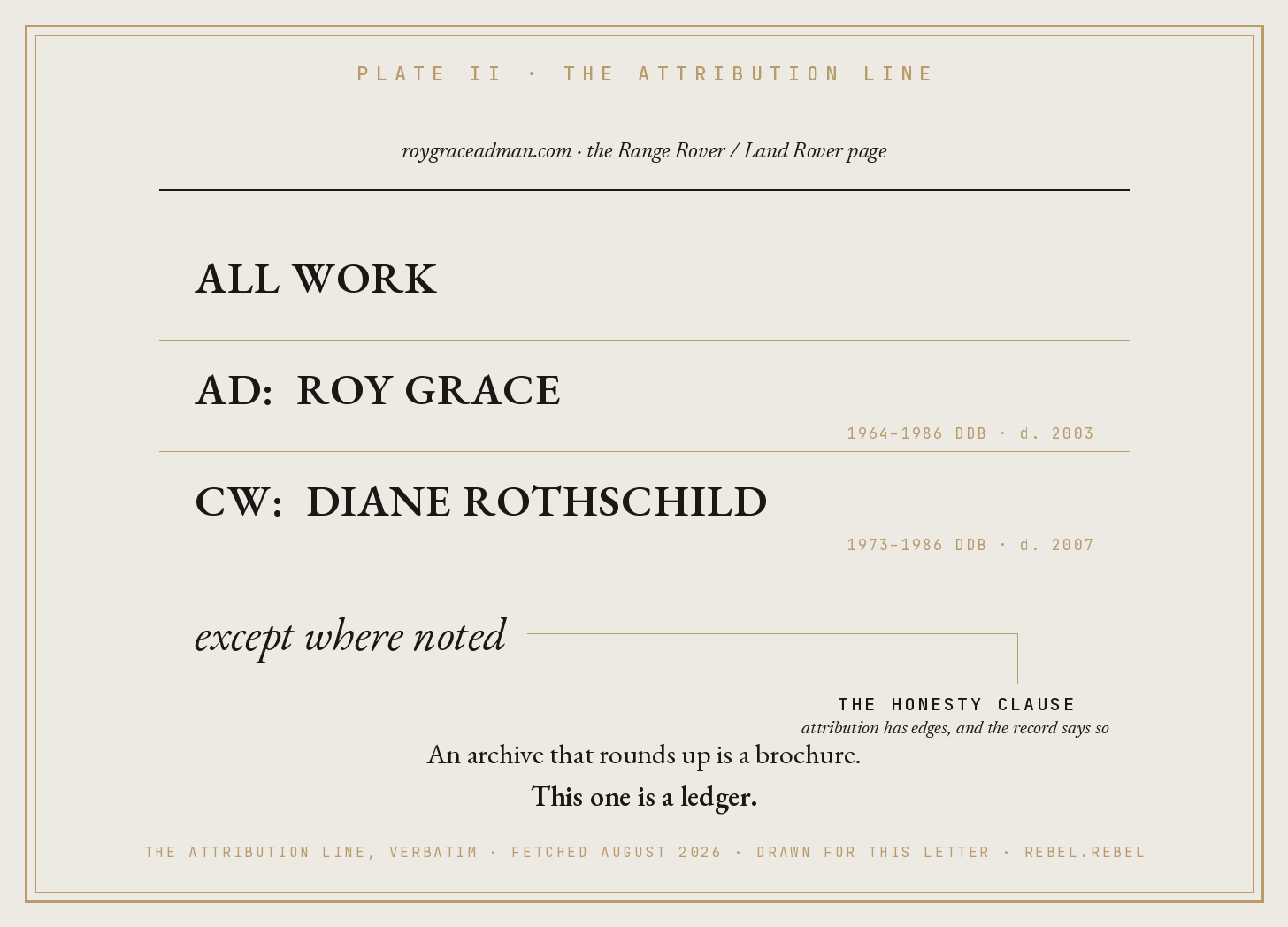
Read it again, because it is the document this letter exists to hold up. It is a receipts block. Two names, their roles, and an honesty clause: except where noted. The clause is doing real work. It concedes that attribution has edges, that some pieces belong to other hands, and that the record will say so rather than round up. An archive that rounds up is a brochure. This one is a ledger.
On July 30, 2026, a copywriter named Vikki Ross posts six of the ads to her feed with a line of plain admiration, my word, and a link to the archive so her readers can see who wrote them. The post is how this letter found its documents, and the path deserves its own entry in the record. The work is thirty and forty years old, and it is still being passed hand to hand by working writers, with the authors’ names attached, because the archive made the names findable.
Provenance is not sentiment. Provenance is infrastructure.
Four decades later, the infrastructure still works.
Meanwhile the category has completed its migration in the other direction. Automotive advertising in 2026 is produced by systems in the fullest sense: holding-company agencies, in-house studios, brand-voice guidelines, legal review, machine generation, layers of approval in which every sentence may be touched by many hands while belonging finally to none.
Who can be blamed for this sentence?
Sit with the question. It is not an accusation that the work is bad. It is an observation that the arrangement no longer routes claims through persons, and that the load path Grace and Rothschild built their company on has been quietly dismantled around the grammar it once carried.
The claim, then, and the record. The claim, made implicitly by every brand book and voice guideline in the category, is that a brand’s voice belongs to the brand, an institutional property, transferable, maintainable, independent of any particular person. The record says something less convenient: one of the most celebrated automotive voices of its era was carried by named people in a firm built to keep the names attached, lasted as long as that firm lasted, and left behind a grammar the category could imitate but not inherit.
That is the gap. It is not small.
VI
A position, staked so it can be shot at.
No major automotive brand operating in the American market today can identify one working writer and one working art director who have carried durable, public authorship of its advertising across years, with their names attached to the work and responsibility for its claims. If such an arrangement exists, or appears, this letter is wrong in its final section and will say so in this text, marked and dated. Review clock: August 2027.
The falsifier was sought before the position was staked. What the search returns is the opposite case, everywhere: campaigns credited to networks, voices credited to guidelines, and a category average any reader can test in the current issue of any magazine. Find the towing capacity stated to the hundred pounds. Find the name.
A voice is not a property.
A voice is a person under load.
It can be employed. It can be partnered with. It can leave the biggest agency in the world and put its name on another door. But it cannot be extracted from the person and stored in a guideline, because the thing that made it a voice was never the vocabulary.
It was the blame.
They put mud on it.
We still know who they were.
RECORD
Real persons named in this letter, held to this block. Body references composited where house law requires.
Diane Rothschild · Copywriter, DDB 1973–1986; Executive Vice President, Creative Director, board member at departure. Co-founder, Grace & Rothschild, New York, 1986. Inducted, One Club Creative Hall of Fame, 2005, fourth woman admitted. Died April 3, 2007, Manhattan, age 63. Source: Adweek obituary, April 2007; One Club records; roygraceadman.com.
Roy Grace · Art director, DDB 1964–1986; Executive Creative Director, DDB Worldwide, and Chairman, DDB US, at departure. Co-founder, Grace & Rothschild, 1986. Four of seventeen classic commercials in MoMA’s collection. Died February 26, 2003, New York, age 66. Source: Variety obituary, 2003; Art Directors Club Hall of Fame; One Club Creative Hall of Fame.
Ron Rosen (art director) and Craig Demeter (copywriter) · Credited on the mansion/snow execution, It not only says you’ve arrived. Source: roygraceadman.com, per-ad credit, noted under the archive’s “except where noted” clause.
Tom Gianfagna (art director) and Gary Cohen (copywriter) · Credited on the snow-road execution, Get to your cancelled flight on time. Source: as above.
Allen Richardson (art director) and Ari Merkin (copywriter) · Credited on the 1995 4.0 SE balloon execution. Source: as above.
Charlie Hughes · President, Range Rover of North America, at the 1986 US introduction; formerly account management, DDB. Source: roygraceadman.com, Range Rover / Land Rover collection page.
Chip Sleeper · Founder/Partner, Grace & Rothschild, 1986–2000. Source of the “They put mud on it” account and the agency’s operating dates. Source: roygraceadman.com, remembrances.
Vikki Ross · Copywriter. Posted the ads with attribution and archive link, July 30, 2026, Substack Notes. Retrieval path for this letter, credited as such.
RECEIPTS
Grace & Rothschild founded 1986, both principals departing DDB; operating dates 1986–2000 per Sleeper. Verified: roygraceadman.com; roverparts.com history, 2026.
Attribution line, verbatim from roygraceadman.com Range Rover / Land Rover page: “All work AD: Roy Grace CW: Diane Rothschild except where noted.” Fetched August 2026.
Awards: One Show pencil winners or finalists most years 1987–2000; Kelly Awards finalist, best magazine campaign, six consecutive years. Source: roygraceadman.com.
Ad copy quoted from the published executions as posted July 30, 2026: launch ad (7,700 lbs, 45 degrees, ~100 mph, north of $30,000, 1-800-FINE-4WD); mansion/snow ad ($33,000-plus); tailgate/canyon ad (quail egg); late-90s snow-road ad; 1995 4.0 SE ad ($54,000, the 2020 line).
The per-ad attribution pass, run before publication, and what it returned. Each of the five quoted executions was checked against the archive’s per-ad credits rather than assumed under the blanket line. Two carry no separate credit and are therefore Grace’s and Rothschild’s own: the 1986 muddy launch and the Utah canyon quail-egg ad. Three carry other hands and are named in the Record above and in the body: mansion/snow to Ron Rosen and Craig Demeter, snow road to Tom Gianfagna and Gary Cohen, the 1995 balloon to Allen Richardson and Ari Merkin. The draft of this letter that existed before the pass treated all five as the partners’ work. It was wrong, the archive’s own clause is what caught it, and §III now says so on the page rather than here. A letter arguing that attribution is infrastructure does not get to round up.
“The single most disqualifying fact a luxury advertisement can contain” is rhetoric, not a sourced industry rule, and is never cited as fact elsewhere in the letter.
Corrections, if any arise, will be entered here, marked and dated.
STAKED POSITION · REVIEW CLOCK
Position stated in §VI. Review: August 2027. Falsifying evidence: a major US-market automotive brand with one working writer and one working art director carrying durable, public, named authorship of its advertising across years, with responsibility for its claims. Corrections entered in this text.
Austin Ripmaster is the founder of Rebel.Rebel. He has held senior brand and creative roles at Nike and adidas.